
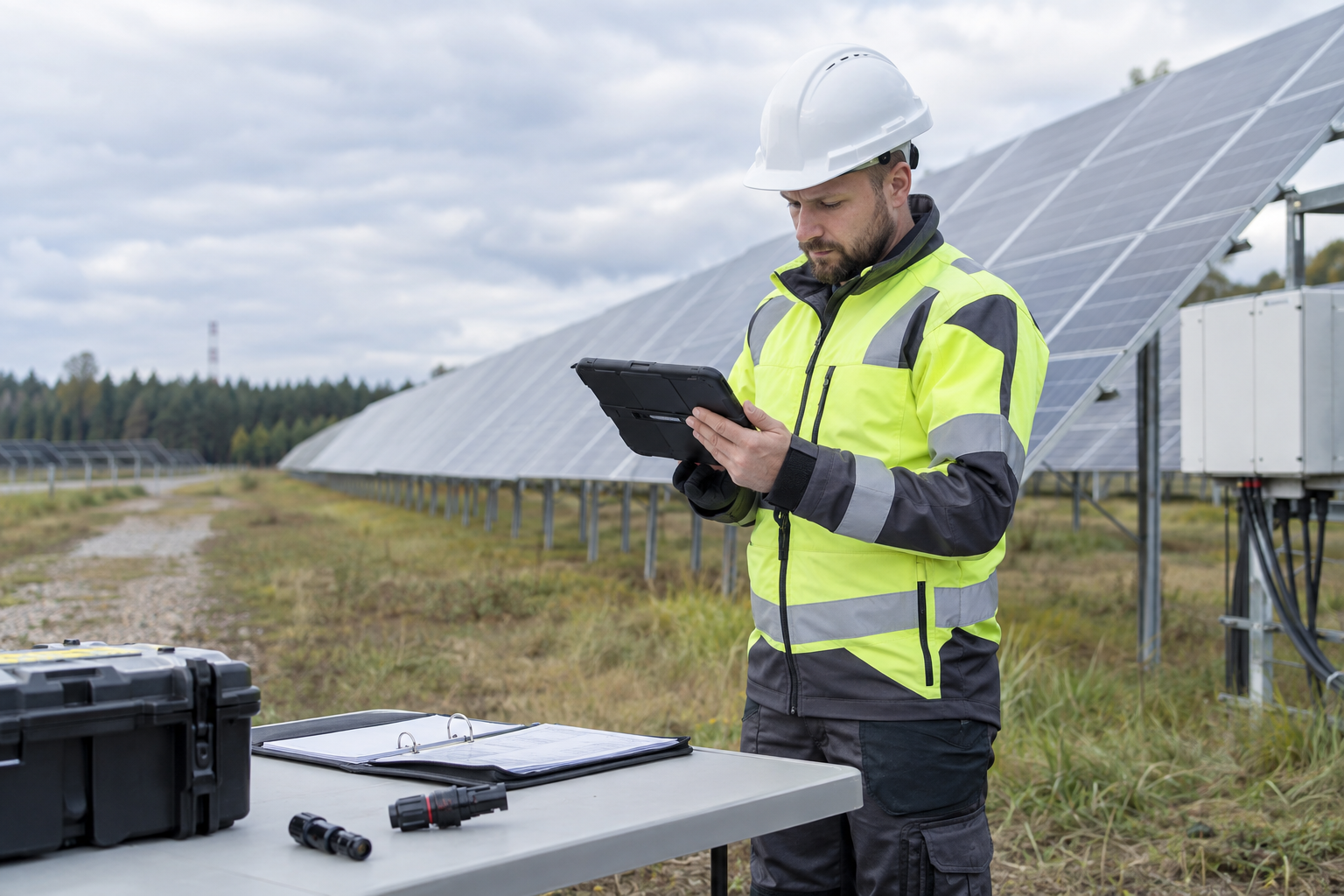
Documented Solar Power Plant Maintenance for Warranty Claims
Documented solar power plant maintenance helps substantiate warranty claims and maintain a transparent equipment history. Learn how to organise your maintenance log, defect evidence, and component replacement records.
Solar Power Plant Maintenance Begins with Transparent Documentation
Preparing a warranty claim can be hindered not only by an unclear cause of defect but also by missing information regarding equipment installation and operation. The owner must be able to identify the faulty component, describe how the problem arose, and present available maintenance records. Documentation itself does not guarantee the claim will be satisfied but helps evaluate what happened and reduces ambiguities in communication with the supplier or manufacturer.
It is recommended to store as-built drawings, commissioning and inspection protocols, an equipment list with serial numbers, warranty terms, and manufacturer maintenance instructions in a unified document archive. In a solar farm, it is advisable to link component identification to a specific inverter, string, and location, so that searching for faulty equipment does not depend on the memory of a single employee.
Maintenance Logbook: Record Not Only What Was Done, But Also What Was Found
Each maintenance record should answer practical questions: when was the work performed, who performed it, what equipment was inspected, what method was used, and what was found. Measurements should include units, relevant working conditions, and the identification of the measuring instrument used. Photographs should be linked to a specific object and defect, rather than saved in a separate folder without explanation.
A panel cleaning record specifies the method used and the essential process conditions, while electrical equipment inspections detail observations, measurement results, and necessary subsequent actions. For each unresolved defect, a responsible person and a deadline are assigned. The maintenance plan is developed in accordance with manufacturer requirements and the applicable LVS EN IEC 62446-2:2020 guidelines; the logbook helps maintain a traceable history of work performed.
MC4 Connectors and Other Components: Replacements Must Be Traceable
MC4 connectors are an example of components whose precise identification is crucial for both safety and the assessment of warranty issues. A visually similar connector shape is not sufficient to conclude compatibility. The manufacturer, the specific connector family, and the manufacturer's specified connection conditions must be verified, without relying solely on a general designation from the distributor.
When replacing a connector, cable, module, or inverter, document the initial defect, the identification of the dismantled and installed parts, the person who performed the work, and the results of post-work inspections. If a warranty claim is possible, ascertain the requirements for retaining or returning the faulty part before disposal. DC circuit work must be entrusted to a qualified electrical specialist; connectors must not be disconnected under load.
How to Prepare a Substantiated Warranty Claim
In the claim, distinguish between the observed problem and the assumption of its cause. For example, an inverter error code or a specific string current deviation is an observable fact, whereas a manufacturing defect still needs to be substantiated. Solar farm monitoring can help determine the onset and recurrence of a problem if historical data and event timestamps are preserved.
The body of evidence should include a description of the problem, the equipment serial number, purchase or commissioning documents, relevant maintenance records, photographs, and diagnostic results. Verify the specific warranty claim procedure and deadlines, and whether approval is required before repair. Safety hazards must be addressed as a priority, documenting the initial state only if it can be done safely.
The Value of Documentation for Owners and Investors
An organised maintenance history helps differentiate recurrent defects from isolated incidents, plan for spare parts, and transfer the asset to another operator. It is also useful in technical due diligence before acquiring a solar farm. Reducing LCOE in this context is associated with the ability to avoid repeated diagnostics and better plan maintenance expenses, but the actual benefit must be evaluated based on the specific asset's costs and energy production.
pvcare.eu can help organise solar power plant maintenance according to LVS EN IEC 62446-2:2020 and include work documentation within the scope of an O&M contract. Depending on the asset's needs, monitoring, robotic panel cleaning, grounds maintenance, and thermal drone inspections with reports on dronepv.eu can be engaged.