
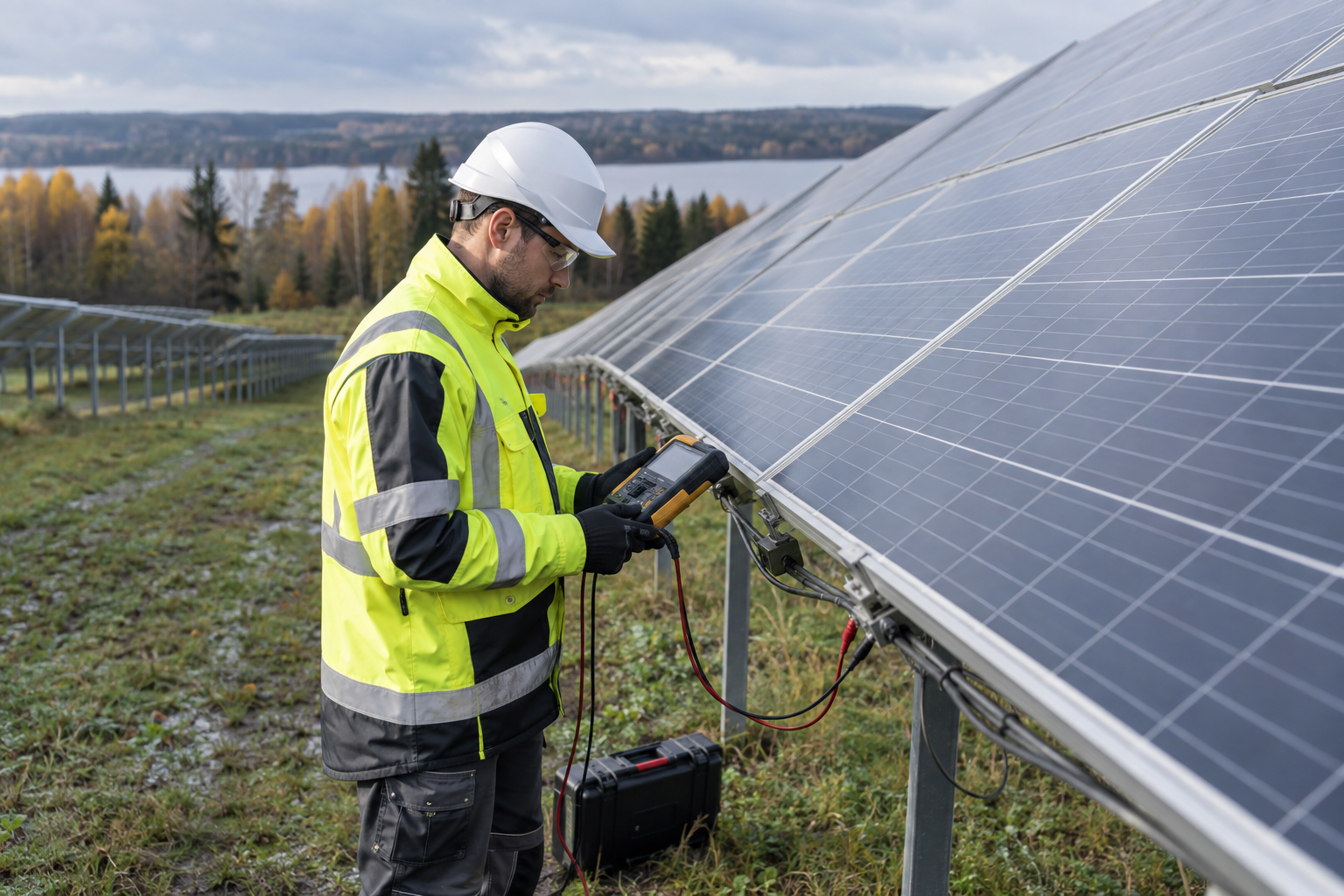
PID degradation: how to identify the risk and choose mitigation measures
PID degradation can reduce solar module output without obvious external damage. We explain its causes, the limitations of diagnostics and the steps needed to make an informed choice of corrective measures.
What is PID degradation and how does it occur?
PID, or potential-induced degradation, is a deterioration in the electrical properties of solar modules which, under certain conditions, is promoted by a potential difference between the solar cells and earthed parts of the module structure. Depending on the module technology, it may involve leakage currents, ion migration and other processes that reduce module output.
The level of risk is influenced by the module design and materials, voltage relative to earth, its polarity, temperature and humidity. This means that different module strings, or even modules within the same string, may be affected differently within a single plant. PID is not the same as normal long-term ageing and cannot be identified solely from the age of the plant.
When is there reasonable cause to suspect PID?
An investigation is worthwhile if, under similar conditions, the output of individual strings consistently falls below that of comparable strings and the difference cannot be explained by shading, soiling, temperature or inverter operating limits. In some PID scenarios, the distribution of losses may be linked to the position of modules within a string and their potential relative to earth, but this indicator alone does not confirm the diagnosis.
Hot spots in solar panels are not synonymous with PID. Localised overheating can also be caused by cell cracks, shading, connection defects or bypass diode problems. Conversely, PID does not always produce a pronounced thermal anomaly, so a thermogram or a drop in energy production alone is not sufficient grounds for replacing modules.
How can suspected PID degradation be investigated?
Diagnostics begin with a review of the technical documentation for the modules and inverters, the string layout and historical operating data. The module technology, the manufacturer's specified operating limits and the system's electrical configuration must be established. Other plausible causes of power loss must be ruled out before drawing conclusions.
A qualified specialist can compare the electrical parameters of strings and measure current–voltage curves, taking irradiance and module temperature into account. Thermography helps identify suspect areas, while electroluminescence testing can provide additional information about variations in cell performance. The results must be assessed together, as none of these indicators is unique to PID on its own.
If field testing leaves the cause unclear, further testing should be agreed with the manufacturer or a specialist laboratory. Electrical safety measurements are important for assessing system condition, but satisfactory insulation resistance does not, on its own, rule out PID.
Corrective maintenance: the solution must suit the module technology
Corrective maintenance must begin with an assessment of the confirmed cause and the manufacturer's recommendations. Some forms of PID may be at least partially reversible, while other damage may persist. Full restoration of output or identical results for all modules must therefore not be promised.
In certain systems, a manufacturer-approved PID mitigation or recovery device may be used, provided it is compatible with the modules, inverters and the plant's electrical configuration. Unauthorised earthing of a DC pole or changes to the voltage operating regime are not permitted: they may create safety risks and fail to comply with equipment requirements.
If the damage is irreversible or the measures do not deliver sufficient results, replacement of the affected modules should be considered. The decision should be based on the measured power loss, the cost of the solution, compatibility and expected future performance. Repeat measurements under comparable conditions are required once the work is complete.
A seasonal maintenance plan with PID risk checkpoints
The seasonal maintenance plan should be designed to ensure that comparable baseline and follow-up measurements are available. It should identify suspect strings, specify the conditions for the selected tests, name the specialists responsible and define criteria for further action. The frequency of testing should be determined by the identified risks and the manufacturer's instructions, rather than an assumption that PID develops in the same way in all systems.
Panel cleaning and the removal of shading help distinguish other sources of energy production losses, but do not themselves eliminate PID. Maintenance records should retain module identification details, measurement conditions and any changes made, so that the results of corrective measures can be assessed objectively.
pvcare.eu can help organise an initial technical condition assessment, a thermal drone inspection with a report on the dronepv.eu website, and maintenance in accordance with LVS EN IEC 62446-2:2020. Where PID is suspected, the test results help establish the basis for further specialist diagnostics and maintenance work.