
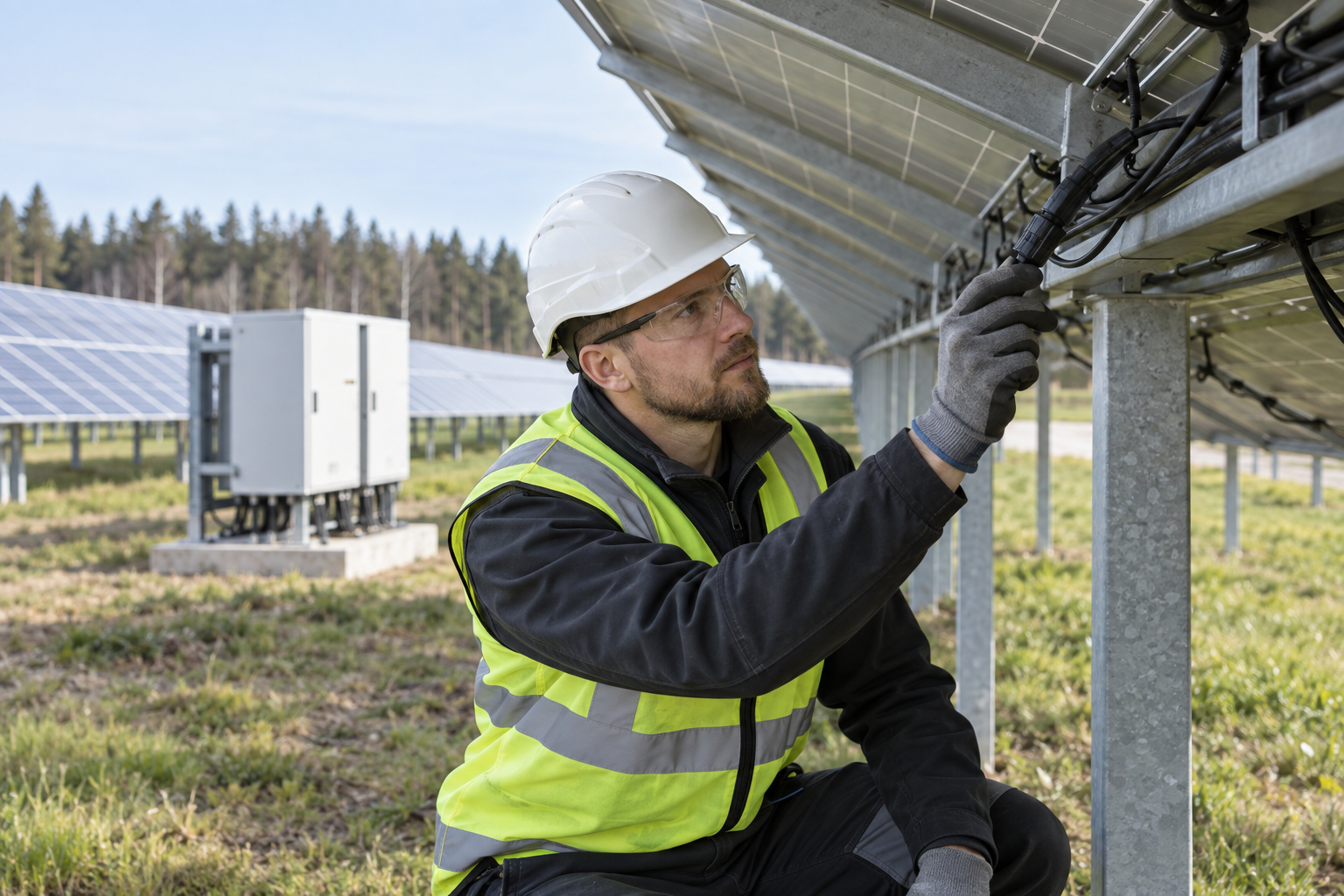

String faults: how to locate a fault in a DC circuit
String faults can be caused by damaged connections, insulation problems or uneven shading. We explain how to distinguish the symptoms, organise safe diagnostics and document repairs to DC circuits.
What are string faults?
A string is a group of solar panels connected in series and connected to an inverter or DC combiner box. The same current flows through all components in the series circuit, so a problem with one panel or connection can affect the performance of the entire string. The term “string faults” does not refer to a single specific diagnosis: it can cover an open circuit, incorrect voltage, reduced current or an insulation fault.
The first task is to determine whether the deviation affects one string, several strings connected in parallel or the entire inverter input. If monitoring only shows aggregate data for the maximum power point tracking (MPPT) input, a problem with an individual string may not be immediately apparent. Diagnostics require an up-to-date connection diagram and unambiguous string labelling.
Current and voltage readings help narrow down the search
If one string shows no current under conditions in which generation is expected, checks should be made for a possible open circuit, a disconnected connection, a tripped protective device or a measurement error. A lower but non-zero current may be associated with shading, soiling or a mismatch in the panels’ electrical characteristics. These symptoms indicate where to investigate, but do not in themselves prove the cause of the fault.
String data should be compared at the same time and only between technically comparable circuits: those with the same number of panels, similar orientation and similar shading conditions. Strings connected in parallel share the same operating voltage, so a voltage reading alone cannot identify the faulty string. When assessing a separately measured open-circuit voltage, panel temperature and the manufacturer’s specifications must be taken into account.
Connections, insulation or localised shading?
Poor connector assembly, mating incompatible connectors, mechanical damage to cables and moisture ingress are possible causes of DC circuit faults. Increased contact resistance at a connection can cause localised heating, while damaged insulation can trigger an inverter insulation resistance fault message. If the fault recurs after rain or during morning dew, this correlation should be recorded in the diagnostic brief.
Not every string deviation indicates an electrical fault. Shading from vegetation and bird droppings on panels can cover cells unevenly and, under certain conditions, cause bypass diodes to conduct or contribute to localised heating. Before replacing components, panel surfaces and surrounding obstructions should be assessed. After cleaning or removing the source of shading, checks should be made to establish whether the deviation persists.
Safe diagnostics: from the fault log to measurements
Work begins with a review of the inverter fault log, the string diagram and the time at which the deviation occurred. A qualified electrical specialist then carries out a visual inspection and selects the necessary measurements: string current, open-circuit voltage, insulation resistance or the current–voltage curve. The measurement sequence and circuit isolation arrangements are determined according to the system design, safe working requirements and equipment manufacturers’ instructions.
Solar panels generate voltage when exposed to light, even when the inverter’s AC side is disconnected. DC connectors must not be disconnected under load, and insulation testing must not be carried out without assessing how connected electronics will be protected. A thermal drone inspection can help locate thermal anomalies, but it does not replace electrical measurements and cannot, on its own, confirm a specific fault.
When can a repair be considered complete?
Simply clearing the fault message is not enough. After the repair, the relevant measurements must be repeated and string operation checked under suitable generating conditions. The work report should state the string identifier, the cause identified, the actions taken, the components replaced and the verification results. If the deviation was associated with moisture or intermittent shading, further monitoring under similar conditions is also required.
If similar faults recur within the same solar farm, a solar farm audit helps assess whether the problem is localised or linked to a common shortcoming in installation, materials or documentation. A solar farm O&M contract can define response procedures, responsibility for diagnostics, repair approval and the handover of verification records to the owner.
pvcare.eu can help organise the assessment of string problems and maintenance in accordance with LVS EN IEC 62446-2:2020, supplemented by a thermal drone inspection and a report on the dronepv.eu website. Depending on the cause identified, robotic panel cleaning with filtered water, grass cutting and ongoing monitoring under an O&M contract are also available.